
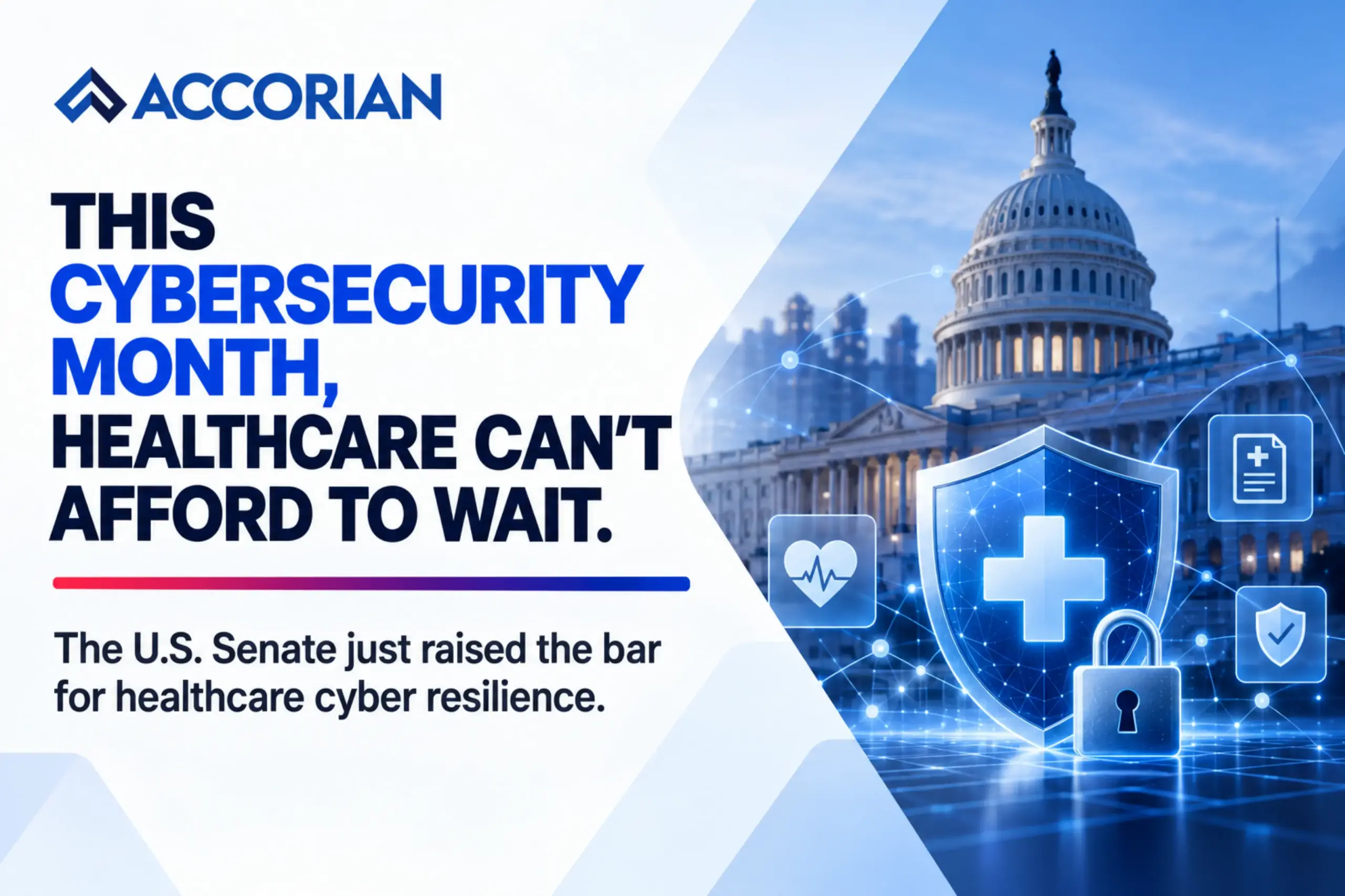
The U.S. Senate has sent a clear message to healthcare organizations:
cybersecurity expectations are moving higher.
On September 30, 2026, the Senate unanimously passed the Health Care Cybersecurity and Resiliency Act of 2026, bipartisan legislation designed to strengthen cybersecurity and resilience across the healthcare sector. The bill would direct the U.S. Department of Health and Human Services (HHS) to modernize the HIPAA Security Rule and raise the baseline for cybersecurity practices expected of HIPAA-regulated organizations.
For healthcare CISOs, vCISOs, CIOs, and security leaders, the important question is not whether the bill has become law. It has not. The House still needs to act, and the legislation would require further regulatory action. But the direction is significant: MFA, penetration testing, stronger cybersecurity standards, risk management, resilience, and coordination across federal agencies are becoming increasingly central to healthcare security expectations.
That means waiting for the final rule before identifying security gaps could leave organizations trying to close technical and governance weaknesses under pressure.
The smarter question is:
How ready is your healthcare security program for a higher cybersecurity baseline?
Accorian helps healthcare organizations answer that question through HIPAA risk assessments, HITRUST readiness and assessments, penetration testing, security assessments, third-party risk management, red teaming, compliance advisory, and vCISO services. Its healthcare security capabilities are designed to connect regulatory requirements with the technical controls and evidence needed to demonstrate security maturity.
What Did the Senate Healthcare Cybersecurity Bill Actually Change?
The Health Care Cybersecurity and Resiliency Act of 2026 proposes a significant shift in how healthcare cybersecurity is approached at the federal level.
The legislation calls for HHS to modernize the HIPAA Security Rule and establish stronger cybersecurity practices for HIPAA-regulated organizations, including multifactor authentication and penetration testing. It also calls for stronger coordination between HHS and the Cybersecurity and Infrastructure Security Agency (CISA), additional support for rural healthcare organizations, and cybersecurity training.
The bill also proposes minimum cybersecurity standards and gives HHS several frameworks to consider during rulemaking. The College of Healthcare Information Management Executives has highlighted the need for a clear, authoritative source of healthcare cybersecurity standards as organizations currently navigate overlapping guidance from federal agencies, industry organizations, and other groups. For CISOs and vCISOs, this matters because the direction of travel is becoming clearer.
Healthcare organizations will increasingly need to demonstrate that cybersecurity controls are not merely documented, but implemented, tested, monitored, and capable of protecting patient data and critical operations.
Is the New Healthcare Cyber Bill Already a Requirement?
No.
This distinction matters.
The Senate has passed the legislation, but it still needs to move through the House. Even if enacted, regulatory implementation would still be required before specific new HIPAA Security Rule obligations become enforceable.
The current HIPAA Security Rule remains in effect. HHS’s existing proposed Security Rule modernization, issued in December 2024, similarly remains a proposed rule rather than the current enforceable standard.
But that does not mean healthcare organizations should wait.
HHS’s proposed rule already provides a useful indication of where cybersecurity expectations are heading. Among its proposals are annual compliance audits, encryption of ePHI at rest and in transit, MFA, vulnerability scanning at least every six months, penetration testing at least annually, network segmentation, backup and recovery controls, and regular testing of security measures.
For a CISO, this creates an opportunity to address the underlying security gaps before regulatory deadlines turn them into urgent remediation projects.
What Should Healthcare CISOs Do Now?
The first step is not rewriting every policy.
It is determining whether the controls your organization already claims to have actually work.
A healthcare CISO should be able to answer:
- Can we identify every system that creates, receives, maintains, or transmits ePHI?
- Have we conducted a current and defensible security risk assessment?
- Where are MFA controls implemented, and where are exceptions still present?
- When was our last penetration test?
- Have we validated that critical vulnerabilities are actually remediated?
- Can we demonstrate that backups and recovery mechanisms work?
- Do our vendors and business associates meet our security expectations?
- Can we produce evidence showing that our controls operate continuously rather than only during an audit?
If answering these questions requires pulling information from multiple spreadsheets, asking individual teams for screenshots, or reconstructing evidence from the previous audit, that is itself a warning sign.
The problem may not be a lack of controls. It may be a lack of security visibility and operational assurance.
Why Is Healthcare Penetration Testing Becoming More Important?
The Senate bill specifically calls for stronger cybersecurity practices, including penetration testing. That is important because healthcare organizations cannot validate security maturity through policies alone.
A policy may state that critical vulnerabilities are remediated promptly.
A penetration test can show whether an attacker can exploit one.
A policy may require strong authentication.
Technical testing can determine whether an exposed application, API, remote service, or privileged account creates a path around those protections. A healthcare penetration testing program should therefore be tied to the organization’s actual attack surface. Depending on the environment, that can include:
- External and Internal network penetration testing
- Web application and API penetration testing
- Cloud security assessments
- Mobile application testing
- Wireless security testing
- Secure code review
- Social engineering and phishing assessments
- Red teaming
- Vulnerability assessments
- AI security assessments for clinical or operational AI systems
The objective is not simply to produce a vulnerability report.
It is to determine whether an attacker can turn a technical weakness into access to ePHI, critical healthcare applications, clinical systems, or business operations.
Does a HIPAA Risk Assessment Need to Change?
It should.
The proposed HIPAA Security Rule modernization emphasizes a more structured and documented approach to cybersecurity risk management. HHS has proposed requiring regulated entities to conduct an annual compliance audit, maintain written documentation, implement stronger technical safeguards, and regularly test the effectiveness of security measures.
Even before any new requirements become final, healthcare organizations should be asking whether their existing HIPAA risk assessment is sufficiently current and technically grounded.
A meaningful HIPAA security risk assessment should identify:
Where is ePHI?
Map where protected health information is created, stored, processed, transmitted, and accessed.
Who can access it?
Evaluate identities, privileges, authentication, and access pathways.
What could compromise it?
Identify technical, administrative, physical, third-party, and operational risks.
What controls exist?
Map risks to the safeguards currently implemented.
Do those controls work?
Validate critical controls through testing and evidence.
What remains unresolved?
Prioritize remediation based on likelihood, impact, exploitability, and business criticality.
Accorian’s HIPAA methodology follows this broader approach, combining scope and applicability, risk assessment and gap analysis, control implementation, evidence management, continuous monitoring, and incident response readiness.
What Does This Mean for Healthcare vCISOs?
For a vCISO, the challenge is even broader.
You may be responsible for cybersecurity strategy across a healthcare organization without directly owning every technical function. You need to determine where the organization’s greatest risks are, prioritize remediation, advise leadership, prepare for audits, manage security initiatives, and demonstrate progress to the board.
The new healthcare cybersecurity direction makes that role more strategic.
A vCISO should be asking:
If the HIPAA Security Rule becomes more prescriptive, which weaknesses in my client’s environment would be hardest to remediate?
- Those weaknesses should be addressed first.
- That may mean commissioning a new penetration test.
- It may mean performing a HIPAA security risk assessment.
- It may mean conducting a third-party risk assessment.
- It may mean building a stronger incident response program.
Or it may mean bringing several disconnected security initiatives into one cybersecurity roadmap.
Accorian’s vCISO model covers security and remediation, assessment and audit, risk management, vulnerability management, security operations, governance, network and cybersecurity assessments, strategy planning, GRC, and board advisory.
That makes the vCISO engagement particularly relevant for healthcare organizations that need to turn emerging regulatory expectations into an executable security program.
What About Third-Party Risk?
This may be one of the most important areas for healthcare CISOs to revisit. Healthcare organizations rarely operate in isolation. EHR platforms, cloud providers, billing companies, health information exchanges, laboratories, medical device manufacturers, SaaS platforms, managed service providers, and other vendors may interact with sensitive information or critical systems.
The Senate bill itself highlights third-party risk as part of the broader healthcare cybersecurity challenge. A vendor questionnaire alone may not provide enough assurance for high-risk relationships. Healthcare organizations should determine:
- Which vendors can access ePHI
- Which vendors connect to critical systems
- Which vendors have privileged access
- Whether vendors undergo independent security assessments
- Whether contractual security requirements are current
- Whether evidence is refreshed periodically
- Whether vendor risks are prioritized based on business impact
For organizations with a large vendor ecosystem, third-party risk management should be treated as part of the cybersecurity program, not a procurement checkbox.
What About HITRUST?
For healthcare organizations looking for a more structured and independently assessed security program, HITRUST can provide another layer of assurance.
HIPAA establishes requirements for protecting ePHI, while HITRUST CSF provides a broader framework that brings together multiple authoritative sources and supports a more structured approach to security and risk management.
This distinction becomes important as healthcare organizations face growing expectations from customers, partners, boards, and regulators.
Accorian supports HITRUST readiness and validated assessments across e1, i1, and r2, alongside HIPAA risk assessments, cybersecurity testing, remediation, and evidence management. Accorian also has HITRUST Authorized External Assessor expertise and direct GORICO integration with HITRUST MyCSF.
The objective should not be to pursue another certification simply because cybersecurity expectations are increasing.
The objective is to build a security program that can demonstrate control effectiveness and withstand independent scrutiny.
How Can Healthcare Organizations Prepare Before the Bill Becomes Law?
Healthcare CISOs do not need to wait for the final legislative or regulatory outcome to begin preparing.
A practical readiness program can start with five steps.
1. Perform a Healthcare Cybersecurity Gap Assessment
Compare the current security program against existing HIPAA obligations, emerging HIPAA Security Rule expectations, applicable industry frameworks, and the organization’s actual risk profile.
2. Validate Critical Technical Controls
Use penetration testing, vulnerability assessments, configuration reviews, and other technical testing to determine whether critical safeguards actually work.
3. Reassess ePHI and Third-Party Risk
Identify where sensitive data resides and which vendors, systems, and services introduce additional exposure.
4. Build a Remediation Roadmap
Not every finding can be fixed simultaneously. Prioritize vulnerabilities and control gaps according to business impact and patient safety implications.
5. Make Evidence Continuous
Instead of preparing for an assessment months in advance, continuously maintain policies, risk assessments, remediation records, technical evidence, and control status.
This is where technology can make a material difference.
Accorian’s GORICO platform is designed to centralize risk identification, control mapping, remediation, and evidence management for healthcare compliance programs.
Why Should Healthcare CISOs Act Before the Final Rule?
Because regulatory deadlines create the worst possible time to discover foundational security gaps.
If MFA exceptions are widespread, implementing them across legacy systems may take months.
If penetration testing has not been performed consistently, scheduling and remediating findings can become a significant project.
If third-party inventories are incomplete, identifying vendors with access to ePHI can take time.
If risk assessments are outdated, rebuilding the organization’s risk picture cannot happen overnight.
And if evidence is fragmented, proving that controls operate effectively can become a major burden when an audit or regulatory review arrives.
Preparation is considerably easier when the organization still has time to prioritize.
The Senate’s unanimous vote is therefore less important as a compliance deadline and more important as a signal.
Healthcare cybersecurity expectations are moving toward measurable, testable, documented, and continuously managed security controls.
What Should Healthcare CISOs Do Next?
If your organization is a healthcare provider, payer, healthtech company, healthcare SaaS provider, business associate, or other organization handling ePHI, now is a good time to establish your baseline.
Ask:
If HHS raised the cybersecurity bar tomorrow, where would we fail first?
If the answer is unclear, start with an independent assessment.
Accorian can help healthcare organizations evaluate their current cybersecurity and compliance posture through HIPAA Risk Assessments, Penetration Testing, Red Teaming, Third-Party Risk Management, HITRUST Readiness and Validated Assessments, and vCISO Services.
The goal is not to prepare for one bill.
It is to build a healthcare security program that can withstand regulatory scrutiny, customer due diligence, cyberattacks, and the operational consequences of a security failure.
Is Your Healthcare Security Program Ready for the Next HIPAA Security Standard?
Don’t wait for the final rule to tell you where your gaps are.
Talk to Accorian about a healthcare cybersecurity gap assessment or HIPAA risk assessment and identify the controls that need attention before regulatory pressure turns them into urgent remediation priorities.