SOC 1
SOC 1 reports are increasingly becoming a contractual requirement
Backed by deep domain expertise and a hands-on, white-glove approach, Accorian guides organizations through every stage from scoping and gap assessment to remediation and final audit readiness. Supported by GORICO, our AI-enabled platform, Accorian simplifies SOC 1 readiness and reporting through a structured, end-to-end approach.
Why Do You Need SOC 1?
SOC 1 is an audit framework developed by the AICPA to evaluate how effectively a service organization manages controls relevant to financial reporting. It includes Type I (control design) and Type II (operating effectiveness over time) reports, assessed by independent auditors. Organizations need SOC 1 because of the following reasons:
Financial Assurance
Client Trust
Regulatory Alignment
Risk Mitigation
Business Enablement
Importance of SOC 1 Attestation
Enhance Trust and Transparency
Explain to clients and stakeholders the strength of your internal controls over financial reporting (ICFR), security, and confidentiality.
Optimize Compliance and Audit Efficiency
Minimize the duration, expenses, complexity of audits, regulatory requirements, and vendor assessments, while seamlessly streamlining operations.
Meet Your Obligations
Provide customized reports that highlight your dedication to security and ICFR compliance to address industry-specific issues.
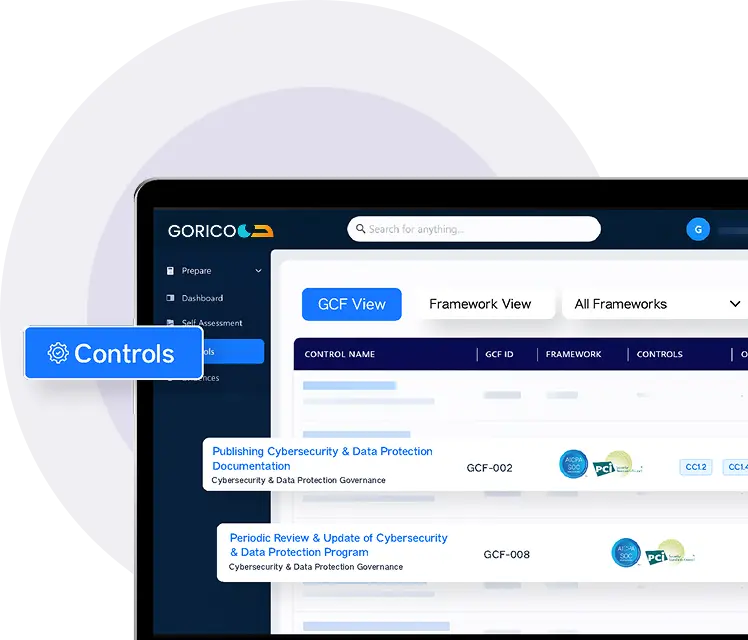
How GORICO Accelerates Your SOC 1 Journey
GORICO, with its AI-enabled capabilities, streamlines the SOC 1 process by centralizing control documentation, automating evidence collection, and enabling structured workflows across stakeholders while reducing manual effort, accelerating reporting, and strengthening governance.
Smarter GRC. Faster Outcomes.
FRAMEWORKS
Evidence Reusability
INTEGRATIONS
Hours SAVED
Types of SOC 1 Reports
01
Type I Report
Now conducted under SSAE 18 (formerly SSAE 16), SOC 1 audits ensure controls are properly designed to support secure and accurate financial reporting, demonstrating a strong commitment to compliance and financial integrity.
02
Type II Report
It provides higher assurance by testing the design and operating effectiveness of financial controls over 6 to 12 months, ensuring they are both properly designed and consistently operating as intended.
The Accorian Approach
Identify in-scope systems and controls, and determine Type I or Type II based on requirements.
Assess ICFR gaps and enhance controls using GORICO-driven insights and structured improvements.
Address control gaps, strengthen design effectiveness, and align with regulatory standards using GORICO.
Conduct a readiness review to validate controls and address any remaining gaps before the audit.
Perform a full audit of control design and effectiveness, delivering a detailed independent report.
Who Should Get SOC 1?
SOC 1 compliance is especially crucial for firms that handle financial reporting or sensitive client transactions. This includes organizations that provide:
Financial Services
Payroll & HR
SaaS Companies
Healthcare
Business Process Outsourcing (BPO)
For medium to large enterprises and expanding startups that provide outsourced financial services or IT solutions, SOC 1 compliance offers significant benefits by promoting stakeholder confidence, supporting regulatory compliance, and strengthening their competitive position in the marketplace.
Difference Between The SOC 1 & SOC 2 Reports
Although both SOC 1 and SOC 2 look at internal controls, they serve different purposes and audiences:
| Aspect | SOC 1 | SOC 2 |
|---|---|---|
| Purpose | Focuses on controls over financial reporting | Focuses on data security and privacy controls |
| Scope | Financial processes impacting client reporting | Security, availability, processing integrity, confidentiality, privacy |
| Standard | SSAE 18 / ISAE 3402 | AICPA Trust Services Criteria |
| Users | Auditors, finance teams, stakeholders | Clients, customers, security teams |
| Use Case | Payroll, billing, financial services providers | SaaS, cloud, and tech service providers |
| Report Types | Type I & Type II | Type I & Type II |
Get Started With Accorian
Accorian is a leading cybersecurity and compliance firm specializing in SOC 1 readiness and reporting. Our auditors, leveraging deep technical expertise and supported by structured workflows within GORICO, conduct comprehensive assessments, perform gap analyses, and implement required controls for Type I and Type II engagements. By strengthening privacy and security measures, we enhance your market credibility and deliver a sustained competitive advantage.
Accorian’s SOC 1 services are designed to strengthen the internal controls over financial reporting (ICFR) that organizations rely on to meet regulatory and client expectations. We assess your financial and IT systems for compliance, identify control gaps or weaknesses, and provide strategic recommendations to remediate risks, ensuring the accuracy, reliability, and integrity of your financial data. Our approach helps build confidence with stakeholders, auditors, and clients by demonstrating your commitment to financial accountability and operational excellence.
Frequently Asked Questions (FAQs)
Q. What is a SOC 1 report?
A. SOC 1 evaluates internal controls over financial reporting (ICFR), providing assurance to auditors and clients.
Q. Who needs a SOC 1 report?
A. Service organizations that impact clients’ financial reporting processes, like payroll, SaaS, or accounting firms.
Q. What is the difference between SOC 1 Type 1 and Type 2?
A. Type 1 examines control design at a point in time, while Type 2 evaluates effectiveness over a defined period.
Q. How does Accorian help with SOC 1 readiness?
A. Accorian conducts gap assessments, documentation reviews, and pre-audit remediation to ensure clean audit outcomes.
Q. How does SOC 1 complement other frameworks like SOC 2 or ISO?
A. Together, they provide a holistic view of security, compliance, and financial control maturity.
Q. What is the difference between SOC 1 and SOC 2?
A. SOC 1 audits internal controls over financial reporting (ICFR), relevant to service providers affecting clients’ financials. SOC 2 evaluates controls around data security, availability, integrity, confidentiality, and privacy – relevant to technology and SaaS providers managing client data.