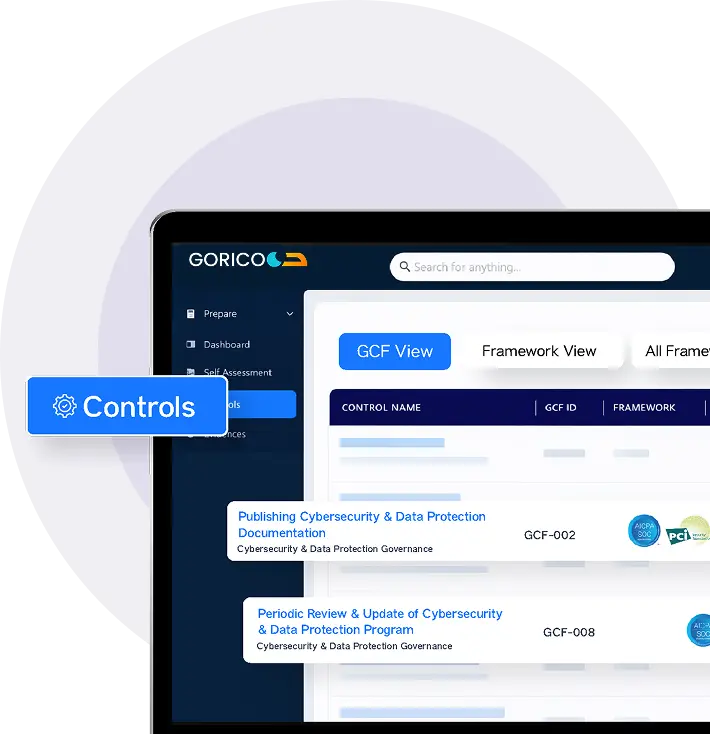
Accorian’s expert team of HITRUST r2 assessors, supported by GORICO, our AI-enabled platform, ensures organizations can effectively manage comprehensive, risk-based assessments and achieve the highest level of cybersecurity and compliance assurance aligned with leading regulatory frameworks.
HITRUST r2 is a 2-year validated, risk-based assessment and the most comprehensive level of HITRUST certification. It uses a tailored set of HITRUST CSF controls based on factors like regulatory requirements, data sensitivity, and system complexity, and evaluates controls across policy, procedure, and implementation to ensure they are fully defined and effectively enforced. Organizations pursue HITRUST r2 for several reasons:
Highest Level of Assurance
Regulatory Alignment
Risk-Based Approach
Market Trust
Comprehensive Coverage
IMPORTANCE OF HITRUST r2 CERTIFICATION
Changes According Risk Profiles
Changes controls to fit the particular risk and compliance requirements of an organization.
Provides Efficiencies & Saves Time
Saves time and effort by employing already conducted HITRUST assessment work.
Highly Comprehensive Certification
Positions organizations as reputable by satisfying very high-level information risk requirements.
Offers Unique Cyber
Insurance Advantages
Provides access to preferred cyber-insurance partnerships, with broader coverage, easier underwriting, and more favorable policy terms
GORICO seamlessly integrates with HITRUST MyCSF to streamline r2 assessments and submission workflows by enabling risk-based control alignment and validation. It leverages AI-powered reviews and expert insights to assess controls across policy, procedure, implementation, identify gaps, and prioritize remediation.
A. The HITRUST r2 is the most rigorous assessment, covering 400+ risk-based controls for organizations in highly regulated industries with complex data environments.
Q. Who needs the HITRUST r2 Assessment?
A. Large enterprises, healthcare providers, and government-facing organizations that manage highly sensitive or regulated data typically require r2.
Q. How does Accorian guide clients through HITRUST r2?
A. Accorian leverages deep assessor experience, control libraries, and GoRICO automation to reduce audit burden and ensure certification success.
Q. What is the difference between HITRUST e1 & r2?
A. HITRUST e1 is an entry-level assurance assessment focused on foundational controls, providing organizations a lighter audit path. In contrast, r2 is the most rigorous HITRUST assessment covering 400+ risk-based controls, suitable for organizations that handle complex, sensitive data and require high assurance.
Q. How long is a HITRUST r2 certification valid, and what happens in year two?
A. HITRUST r2 certification is valid for two years, with a required interim assessment at the one-year mark to confirm controls remain effective before the full two-year cycle is complete.
Q. What's the difference between HITRUST i1 and r2 assessments?
A. i1 uses a fixed set of implemented controls suited to moderate assurance needs, while r2 tailors its control set to an organization’s specific risk profile, regulatory obligations, and data sensitivity, making it the more rigorous and comprehensive of the two.
Q. Does HITRUST r2 certification satisfy other compliance frameworks?
A. HITRUST r2’s control set maps to multiple frameworks, including HIPAA, NIST, and ISO 27001, so many organizations use an r2 certification to reduce the number of separate framework-specific audits they need to undergo.
Q. What should an organization have in place before starting a HITRUST r2 assessment?
A. A defined assessment scope, documented policies and procedures aligned to the selected controls, and at least 90 days of demonstrated control implementation are typically required before the validated assessment can begin.